Etsy — a marketplace for merch, prints and applied art: how artists, illustrators and makers sell worldwide
Etsy is the largest marketplace for handmade goods, vintage and digital products. We’ll look at how to open a shop, how much the platform takes on a sale, and what matters for artists, illustrators and makers.
What the platform is
Etsy is the largest global marketplace for handmade goods, vintage and digital products, a public company on NASDAQ. The scale is huge — tens of millions of buyers and millions of sellers, with almost half of orders coming through the mobile app.
The platform’s bet is on smart AI search rather than purely keyword-based, a buyer loyalty programme and an emphasis on originality (Creativity Standards).
How to start and what to sell
Getting going: register a shop (there’s a one-off opening fee — see below), connect Etsy Payments (an ID plus a bank account) and add your first items. A listing takes up to 10 photos and videos and 13 tags; a digital product — up to 5 files of 20 MB each.
Under the Creativity Standards, every item is assigned to a category (made, designed, curated or sourced by the seller). AI art is allowed only from your own prompts and with a note in the description.
Merch without a warehouse (print-on-demand)
For many artists this is the main scenario on Etsy. You upload your design, and a service partner (Printful, Printify, Gelato) prints the item for each order and ships it straight to the buyer. You don’t have to make, store or send anything: Etsy handles payment and order processing, and the partner handles production and delivery. Selling T-shirts, prints, posters or mugs runs almost without your involvement — you only work on the design.
The economics are simple: the partner keeps the print cost out of the item’s price, and the rest (minus Etsy’s fees) is yours. The formal rules: the listing must name the producer, and the design must be your own.
What you give up
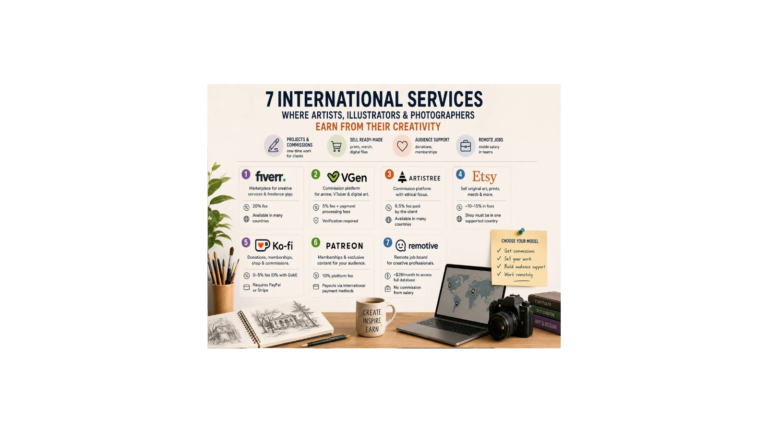
On official rates (as of 2026): the listing fee is $0.20 per item for 4 months (charged whether or not it sells); the transaction fee is 6.5% of the price plus shipping; payment processing depends on the account’s country (the eurozone — 4% + €0.30).
Offsite Ads — 15% on an attributed order (after $10,000 in annual sales the rate drops to 12%, but you can no longer switch the programme off). Currency conversion — 2.5% if prices aren’t in your account’s currency. Plus the one-off shop opening fee and, optionally, an Etsy Plus subscription. The total load comes to about 10–15% of a sale.
Who the site is open to
Payouts go only through Etsy Payments to a bank account in the shop’s country of registration. Supported countries include the US, Canada, the UK, the whole EU, Norway, Switzerland, Turkey, Israel and others.
Through Payoneer (money in dollars into a wallet, then on to a local account, a fee of about 3%) it works for, say, Ukraine, Georgia, Kazakhstan and Serbia.
The main rule: you can sell if you live in an Etsy Payments country and have an account, ID and address there. Opening a shop under someone else’s details breaks the rules and leads to a ban along with your funds. For the diaspora in the EU it all works normally (a local bank account, payouts in euros).
Note: Etsy applies reserves to new shops — holding back part of your revenue for 45+ days, especially without a shipping tracking number.
Tips
Set prices in your account’s currency — you’ll save the 2.5% conversion fee. Write titles in plain language (up to
15 words), not a string of keywords; there’s an AI helper in your dashboard to rewrite them. Build shipping into the price.
Reply to messages within a couple of days — conversion is higher. Aim for the Star Seller badge (fast replies, on-time dispatch with a tracking number, a 4.8+ rating). Only turn on Etsy Ads once you’ve had your first organic sales.
What changed in 2026
A one-off shop opening fee has appeared (since 2024) — the “open for free” line from older articles is no longer true.
The Creativity Standards replaced the old handmade policy: AI art is now allowed with a label, as is printing on your own design. Search has become personalised and AI-driven.
The platform’s numbers are growing again — the “Etsy is declining” claim from older articles is out of date.