INTERNATIONAL JOB OPPORTUNITIES AND EUROPEAN EDUCATIONAL PROGRAMMES IN THE ARTS AND CULTURE

This section brings together international full- and part-time jobs, remote and project-based work, freelance opportunities, paid internships and educational programmes. It also features platforms and services through which artists and cultural professionals can search for work, find creative commissions, gain new skills and develop their careers.

No deadline
Artistree — how artists can accept commissions without paying commission

Artistree — how an artist or illustrator can take art commissions with no fee

A step-by-step look at Artistree: why it’s free for the artist (the client pays), order forms and refund protection, Stripe …
No deadline
VGen — how an artist can take on VTuber commissions

VGen — how an artist can take on commissions on a marketplace for VTubers and streamers

A step-by-step look at VGen: why you need an invite code, the 5% artist fee, the storefront and client requests, …
No deadline
Upwork — freelance jobs for designers and illustrators

Upwork — how illustrators and designers can win freelance work from clients abroad

How illustrators and designers work on Upwork: sign-up and checks, the variable 0–15% fee, ready-made packages, payouts, and who it’s …
No deadline
We Work Remotely — remote work for designers abroad

We Work Remotely — how a designer or digital artist can find remote work abroad

A step-by-step look at We Work Remotely: how to find remote design jobs for free, what the country tags mean, …
Remote work as a 3D animator — Axis Digital

Mid Level 3D Animator — a remote 3D animator job in Blender at Axis Digital studio

A remote 3D animator job in Blender at an Austin studio (Netflix, DreamWorks, IMAX): animating people and robots, hourly pay, …
No deadline
Fiverr — how illustrators can sell their services abroad

Fiverr — how an illustrator or digital artist can sell services to clients abroad

A step-by-step look at Fiverr: how to build a gig, what the platform takes (20% plus a client fee), how …
No deadline
Banner graphic: 'Want to work from home?' with Remotive branding and remote-work logos on a beige background.

Remotive — how a designer or digital artist can find remote work abroad

A step-by-step look at Remotive: what it charges, how to get new design jobs by email for free, what the …
Exhibition producer job in Brussels — argos

Exhibition and Event Producer — an exhibition producer job at the argos arts centre in Brussels

Exhibition producer role at argos arts centre in Brussels: hybrid, English-speaking, permanent part-time position, apply by email before 25 August …
 Праца асістэнтам куратара ў Вене — Kunsthalle Wien

Assistant Curator — a curatorial role at Kunsthalle Wien in Vienna with a salary from €3,000 per mon…

A permanent curatorial role at a Vienna contemporary art institution, from €3,000 gross monthly. Fluent German required; applications close 23 …

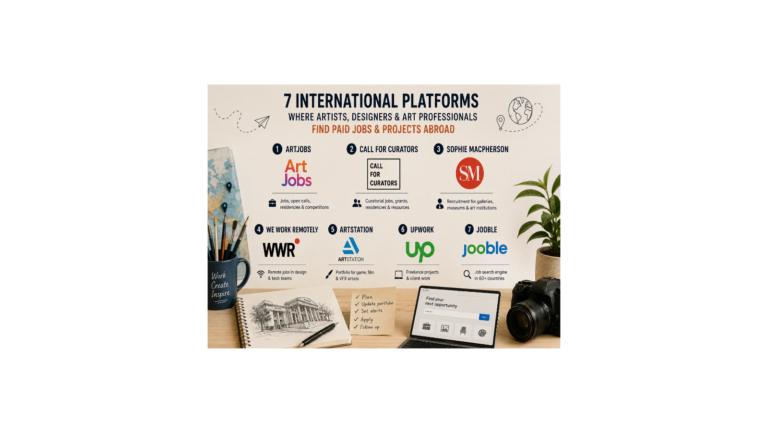
Today, artists can find work beyond galleries and museums. International platforms help you find vacancies, paid internships, project-based work, and career opportunities in the arts. For roles at art institutions, try ArtJobs and Sophie Macpherson, which post openings at museums, galleries, art fairs, and studios. ArtStation helps digital artists find projects and employers, Call for Curators gathers jobs, grants, and opportunities for curators and arts managers, and Jooble lets you search for jobs and remote positions across European countries. ArtCurator also publishes hand-picked vacancies, internships, project roles, and other opportunities for creative professionals.

We select only paid positions: roles at European museums, galleries, foundations, and cultural organisations, as well as fully remote roles open to professionals from Europe or from any country. These can be full-time jobs, paid internships, project contracts, or freelance work. For every vacancy we clearly state the essentials: the salary or fee (when the employer discloses it), language requirements, whether you need the right to work in the country, the type of employment, and the application deadline. We verify the facts on the employer’s official page rather than taking them second-hand, and we note right away which specialists the role suits. That way a reader sees in a minute whether it’s worth applying, without wasting time on listings with hidden terms.

Remote vacancies for designers, illustrators, and digital artists are posted on international platforms like Remotive and We Work Remotely — both have dedicated design and creative sections, and you can set up alerts for new openings. Game and digital artists will find ArtStation useful, with its filter for remote positions. Remote roles vary widely: from motion and graphic design to concept art and illustration. One important nuance: “remote” doesn’t always mean “from anywhere in the world” — some vacancies are limited to a specific country, region, or time zone, so always check the availability and pay conditions in the description. In ArtCurator listings we state country availability directly in the text, so you won’t have to hunt for it in the fine print.

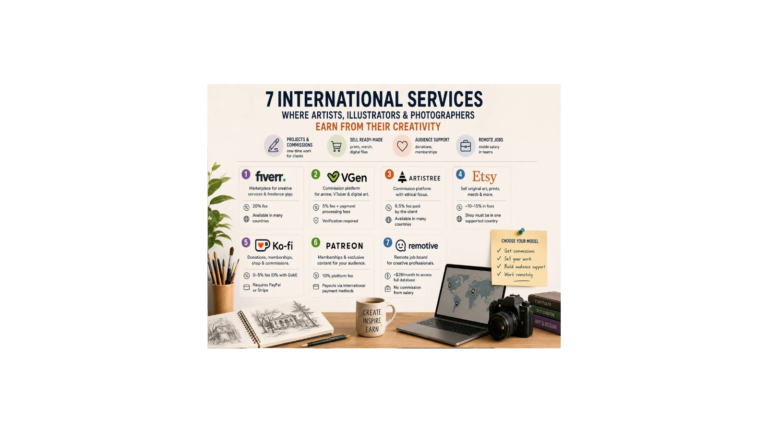
Individual commissions — portraits, characters, illustrations, covers — are found on specialised platforms. On Upwork, clients post specific illustration and design tasks, and the platform’s fee is visible before you send a proposal. Fiverr works the other way around: the artist lists ready-made services, and clients find them through the internal search. For digital and character art, anime, and VTuber design, VGen is a good fit, with a low fee and payouts to most countries. Artistree works as a portfolio profile with order forms, where the fee is mostly covered by the client, while Ko-fi is convenient for taking commissions from an audience you already have on social media.

Beyond commissions, artists sell finished pieces and files. Etsy has the largest audience of buyers: photo-based portraits, custom work, prints, and digital products — colouring pages, clipart, templates, brushes — all sell well there. You can even sell an image without producing anything yourself: a print-on-demand partner handles printing and shipping of a poster or T-shirt. Digital artists will also like the ArtStation marketplace — brushes, tutorials, and 3D assets for a gaming audience. The main advantage of digital goods: one file sells many times over and can bring in income for years.

A stable artist’s income usually comes from several sources. There’s commercial illustration — books, games, packaging, advertising. Image licensing, where a brand buys not the artwork but the right to use it on fabric, packaging, or a cover — for an agreed term and print run. Teaching — lessons, mentoring, portfolio reviews. Subscriptions to exclusive content through Patreon for regular income. Murals and space design for businesses and cities. A reliable approach is to combine two or three directions: commissions bring quick money, digital products bring repeat sales, and teaching or subscriptions bring stability.

The red date shows the application deadline for a specific vacancy — prepare your CV, a portfolio tailored to the role, and a cover letter in advance; early applications get more attention. If there’s a «No deadline» mark instead of a date, you’re looking at a platform where opportunities are posted continuously — you can visit any time.

A few rules protect an artist from unreliable clients. Don’t start work without an upfront payment or a funded milestone. Put the scope, deadlines, and number of revisions in writing. Don’t switch to “direct” payment at the request of an unfamiliar client — off-platform, the platform’s transaction protection no longer applies. Never pay a client an “insurance,” “registration,” or “verification” fee — genuine clients don’t ask money from the freelancer; that’s a sign of a scam. Transfer usage rights to the work only after full payment.

If you would like to submit an international opportunity for publication, please contact us by email